
Product selection
How to Choose Self Drilling Screws for Metal Roofing
Drill point, length, head, washer and coating — the five decisions that separate a roof that stays watertight for fifteen years from one that leaks after two monsoons.

Every leaking metal roof we get called about comes down to one of five decisions made wrong at the ordering stage. Choosing self drilling screws for metal roofing is not complicated, but each of those five choices has to be made against the actual roof rather than against habit. Not workmanship, not the sheet, not the design — the screw specification. Here is how to get each of those five right.
Start with the base steel, not the sheet
1. Match the drill point to the purlin
This is the decision people get wrong most often, and it is the one that costs the most in labour.
The drill point number describes how much steel the screw can bore through before the thread starts to form behind it. It has nothing to do with the roofing sheet, which the point passes through almost instantly. What matters is the purlin or girt underneath.
| Drill point | Base steel capacity | Typical use |
|---|---|---|
| #2 | up to 2.0 mm | Light-gauge purlins, sheet-to-sheet stitching |
| #3 | up to 3.0 mm | Standard Z and C purlins on most sheds |
| #4 | 3.0–5.0 mm | Heavier secondary steelwork |
| #5 | 5.0–6.0 mm | Hot-rolled sections, base plates |
Two failure modes follow from getting this wrong. A point that is too short burns out before it breaks through — the operator leans harder, the point glazes, and the screw spins in a partly formed hole. A point that is too long for thin material can strip the thread as the flute re-enters from the far side, so the screw goes in but never develops any clamp.
Measure the purlin. Do not assume, and do not order by what worked on the last job.
2. Get the length from the whole stack
The rule is simple: at least three full threads must project past the far face of the base steel.
Add up the sheet thickness, any insulation or spacer, the purlin thickness, then add roughly 10 mm for the drill point flute and three threads. For 0.5 mm sheet on a 2 mm purlin, a 45 mm screw is comfortable. Add a 50 mm insulation layer and you are into 100 mm territory.
Under-length screws are the quiet failure. The joint looks finished from below and holds under dead load, but there is nothing engaged to resist wind uplift, which is the load case that actually matters on a roof.
3. Choose the head for the job it is doing
For the sheet itself, a hex washer head is effectively the only answer. It is the only head that carries a bonded washer, it takes a nut setter rather than a bit that can cam out, and its wide flange spreads clamp load across the sheet crown.
Everything behind and beneath the sheet is different:
- Pan head screws for metal-to-metal work like flashing sub-frames and ducting.
- Truss head screws where the material is thin enough that pull-through is a real risk.
- CSK head screws where a following layer has to sit flat over the fixing.
4. The washer is not an accessory
A bonded EPDM washer is a vulcanised rubber seal bonded to a steel cap. The cap controls compression; the rubber does the sealing. Loose washers, or a rubber washer with no cap, will over-compress and extrude the moment the screw is driven a fraction too far.
Two sizes cover most Indian roofing work: 16 mm for standard profiles and 19 mm where the specification asks for a larger bearing area or the sheet is thinner than usual.
How to know it is right: stop driving the instant the EPDM begins to bulge slightly past the edge of the cap. That is the design compression. Another half turn dishes the sheet into a shallow bowl around the fixing, and that bowl will hold water for the life of the roof.
5. Match the coating to the site, not to the budget
This is where the real long-term cost sits.
Zinc plated — 5 to 12 microns of electroplated zinc, typically 72 to 120 hours of salt spray resistance. Correct and economical for inland, sheltered industrial roofs. See zinc plated self drilling screws.
Xylan coated — a PTFE-loaded fluoropolymer over a phosphate base, routinely clearing 1,000 hours of salt spray. It also drives with noticeably less torque and can be colour-matched to coated sheet. The sensible middle specification for humid, semi-coastal and architectural work. See Xylan coated screws.
Bi-metal — an austenitic stainless body friction-welded to a hardened carbon steel drill point. The only correct answer for direct coastal exposure, chemical plants and rooftop solar, where the fixing has to last as long as the asset it holds down. See bi-metal and epoxy coated screws.
The economics are not close. On a 2,000 square metre roof the difference between zinc and bi-metal fasteners is a few tens of thousands of rupees. Re-sheeting a roof because the fixings failed at year eight is a different order of number entirely.
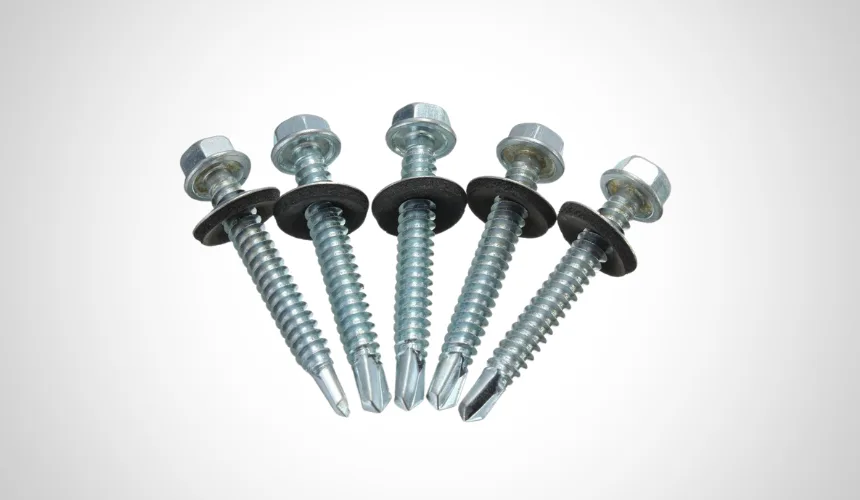
A worked example: sizing self drilling screws for metal roofing
Warehouse roof, Hosur Road. 0.5 mm colour-coated galvalume sheet, 2 mm Z-purlins at 1.5 m centres, 30 km inland.
- Drill point: #3 (2 mm base steel)
- Length: 0.5 + 2.0 + ~10 mm clearance and thread projection → #12 x 45 mm
- Head: hex washer, 8 mm drive
- Washer: 16 mm bonded EPDM, colour matched to the sheet
- Coating: Xylan — inland, but colour-coated sheet means visible fixings, and the coating life should match the sheet's
The relevant reference for the zinc plating on these screws is ASTM B633, and the salt spray figures quoted throughout are measured to ASTM B117.
Ordering note: add roughly 5 percent for wastage and offcut rows, and order a matching magnetic nut setter with every 5,000 screws. A worn socket scrapes coating off the screw heads, and each scrape becomes a rust streak down a coloured sheet.
Common mistakes worth naming
Fixing through the valley instead of the crown. Water sits in the valley. Every valley fixing is a leak waiting for the washer to age.
Re-using a backed-out screw. The thread it formed is gone and the coating on the flanks is damaged. Move to a fresh position.
Mixing grades of self drilling screws on one roof. The cheapest ones fail first, stain the sheet, and the whole installation gets the blame.
Running the driver at full speed on thick purlins. Heat glazes the point. Drop to 1,200–1,800 rpm as base steel thickens and keep firm, constant pressure through breakthrough.
Getting it specified
Send us the sheet profile, the purlin gauge, the distance from the coast and whether the sheet is coated, and we will come back with the exact size, grade and quantity — usually the same working day. We hold self drilling screws for metal roofing in every head and coating combination described here, in stock in Bengaluru. Our full self drilling screw range covers every head and coating combination described here.
Need this specified for a live job?
Send us the substrate, the load and the environment and we will confirm the right size and grade — usually the same working day.