
Product selection
Blind Rivet Grip Range Explained (and Why Your Rivets Are Loose)
Grip range is the single specification that determines whether a blind rivet joint works. Length alone tells you almost nothing, and that confusion causes most loose rivets.
If you have ever set a batch of rivets and found half the joints slightly loose, the rivets were almost certainly not faulty. They were the wrong blind rivet grip range for the material you were joining.
What blind rivet grip range actually means
Blind rivet grip range is the minimum and maximum total material thickness a rivet will properly join. It is printed on every box, usually as something like "3.0–6.0 mm".
It is not the same as rivet length. A rivet has to be longer than the material it joins, because part of its body is consumed forming the head on the blind side. How much gets consumed depends on the rivet design, which is why the manufacturer states a grip range rather than expecting you to work it out.
What goes wrong at each end
Grip too short for the stack. The mandrel is pulled but there is not enough body left beyond the far sheet to deform into a proper head. You get a partial head, or none at all, and a joint that will pull apart under very little load. Sometimes the mandrel will not break cleanly, which is your warning.
Grip too long for the stack. The body has excess length and buckles inside rather than clamping. The mandrel breaks, the rivet looks set from the front, and the joint stays loose. This is the failure people notice a week later, and it is the more common of the two.
Note that both failures can occur with a rivet that is technically "the right length" for the material. The grip range is what tells you it will work.
How to choose the right blind rivet grip range
Step 1 — measure the whole stack. Every layer. Two 1.2 mm sheets plus a 0.8 mm bracket is 3.2 mm, not 2.4 mm. Gaskets, washers and paint build-up all count.
Step 2 — pick a blind rivet grip range that brackets that figure comfortably. For 3.2 mm, a rivet rated 3.0–6.0 mm is ideal. One rated 1.5–3.2 mm is right at its limit and will be inconsistent.
Step 3 — check the hole size. Rivet diameter plus 0.1 to 0.2 mm.
| Rivet diameter | Drill size |
|---|---|
| 3.2 mm | 3.3 mm |
| 4.0 mm | 4.1 mm |
| 4.8 mm | 4.9–5.0 mm |
| 6.4 mm | 6.5 mm |
Drilling to exactly the rivet diameter makes insertion difficult and can shave the rivet body as it goes in. Drilling much oversize leaves the joint slack even with the correct grip range.
Clamp before you set
This is not a sizing issue but it produces the same symptom.
A blind rivet forms its head against whatever the far sheet happens to be doing at the moment it sets. If there is a gap between your two sheets when you pull the trigger, that gap becomes permanent — the rivet has clamped the sheets in their separated position and no amount of tightening afterwards will close it.
Clamp first. Every time.
Which rivet type
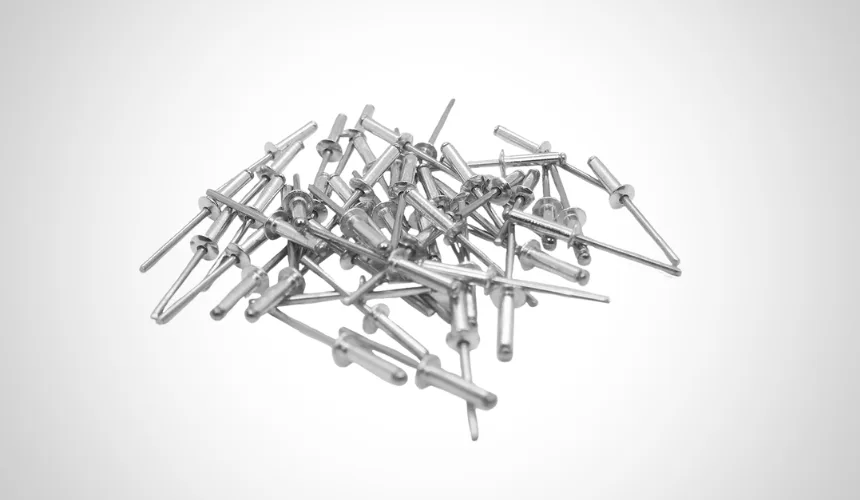
Open-end — the standard, economical choice. The mandrel hole runs through the middle, so the joint is not sealed.
Closed-end (sealed) — the tail is closed, giving a watertight and gas-tight joint. Essential for tanks, external enclosures and anywhere moisture ingress through the fixing would be a problem.
Multigrip — a wider grip range in a single part number, which cuts down the number of sizes you have to stock. Useful for maintenance and repair work where the stack thickness varies.
Structural — a retained mandrel that stays locked in the body after setting, giving substantially higher shear and tensile capacity.
Open-end blind rivet geometry is standardised in DIN 7337 and its ISO equivalent, ISO 15977, which is where the published grip ranges come from.
Match the materials
An aluminium rivet in a stainless sheet, or a steel rivet in aluminium, will corrode at the joint within a season in Indian humidity. The two metals form a galvanic cell and the less noble one goes first.
Match the rivet to the parent material wherever you can:
- Aluminium body, aluminium or steel mandrel — light non-structural work, aluminium sheet.
- Steel body — where shear strength matters and both sheets are steel.
- Stainless SS 304 — corrosive, exterior and coastal duty.
Where mixing is unavoidable, use an isolating washer or specify a stainless rivet, which is the more tolerant option.
The tool matters too
A hand riveter covers 2.4 mm to 4.8 mm rivets. It will not set a 6.4 mm rivet, and it will struggle with 4.8 mm stainless — that needs a lazy-tong or a pneumatic tool, because it is a straightforward question of pull force.
If a tool starts slipping on mandrels, the jaws are worn or packed with debris. Strip the nose assembly, clean it and inspect the jaw teeth. Jaws are a consumable, and replacing them costs a fraction of what a batch of improperly set rivets costs. Our rivet gun range covers hand and lazy-tong tools with replaceable jaws and full nosepiece sets.
Checking a set rivet
- The mandrel snapped at or just below the head. A mandrel standing proud means it is not fully set — drill it out and replace it rather than nipping the stub off.
- The head sits flat and centred, not tilted. Tilt means the tool was rocked mid-pull.
- The sheets are tight together with no movement.
Removing a rivet
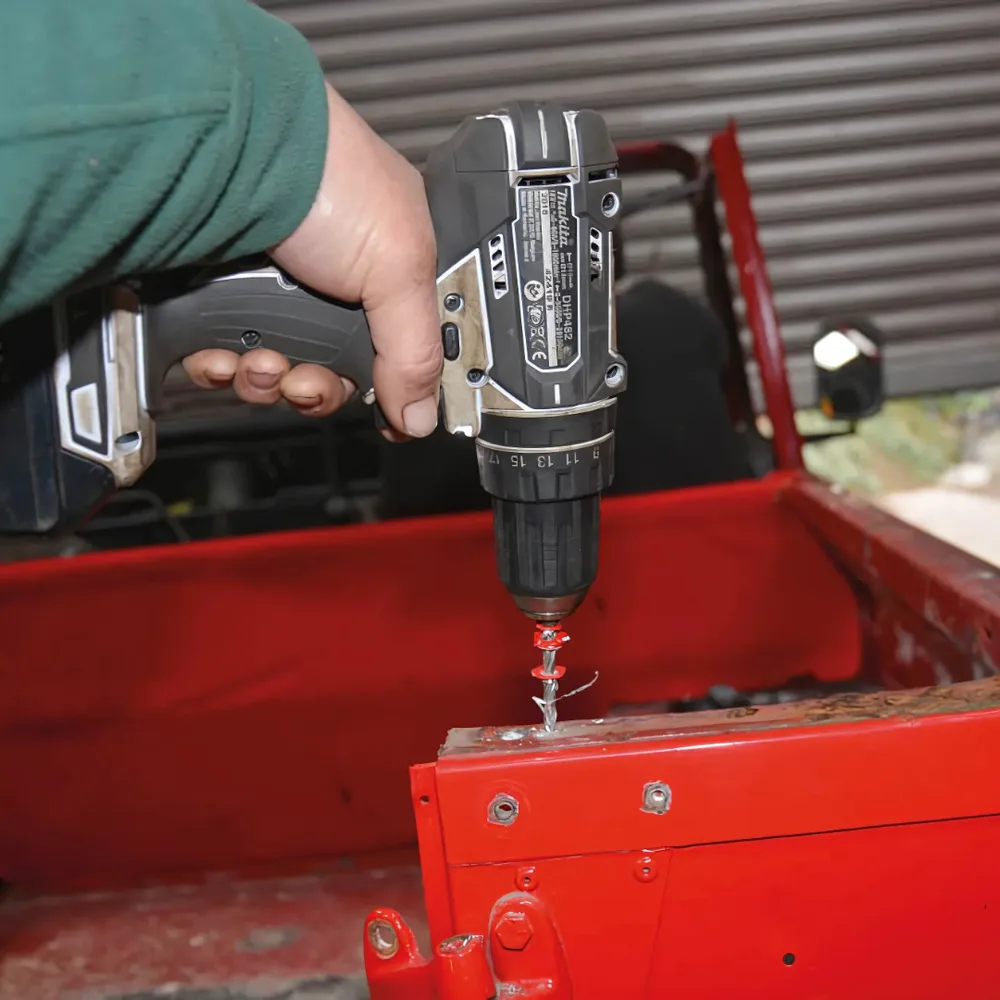
Drill through the head with a bit slightly smaller than the rivet body until the head separates, then punch the remaining body through. The hole can usually be re-riveted with the next size up.
Every box we supply states its blind rivet grip range on the label. Our full blind rivet range runs from 3.2 mm to 6.4 mm in aluminium, steel and stainless, in open-end, closed-end and multigrip types. Send us your material stack and we will confirm the grip range.
Need this specified for a live job?
Send us the substrate, the load and the environment and we will confirm the right size and grade — usually the same working day.